Why Process Simulation Is the Strategic Advantage Your Process Intelligence Program Needs
- Published Date: March 25, 2026
Visibility Alone Isn’t Enough
Process Intelligence has transformed how organizations understand their operations. With technologies like process mining and automated discovery, we can finally see how work actually flows across systems, people, and documents.
But visibility alone doesn’t drive transformation.
Knowing where bottlenecks are is powerful. Knowing which improvements will deliver the highest business impact before spending a dollar is game‑changing. This is where process simulation becomes the strategic differentiator.
When process simulation capabilities are powered by machine learning and based on historical event data, it allows organizations to ask “What if?” and get quantifiable answers to minimize the risk. And the results can be dramatic.
In a recent webinar with QPR, we showcased an example of how this was applied in the real world. You can click here to watch the recording.
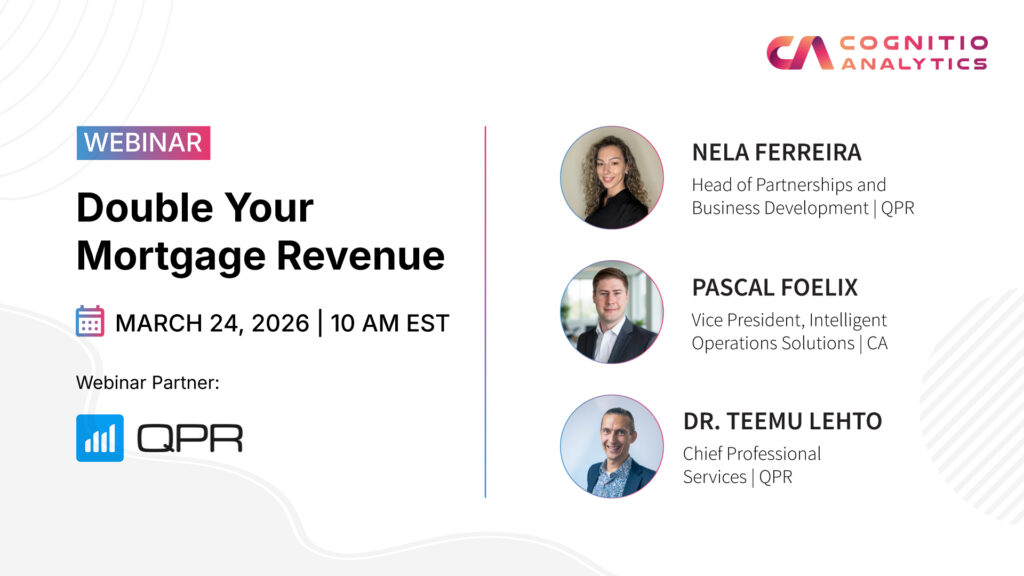
Case Study: How a Mid-Sized US Bank Doubled Mortgage Origination Revenue Using Process Simulation
A mid-sized U.S.-based bank faced a familiar challenge: the mortgage origination process was too slow, too manual, and too inconsistent. Clients that submitted a mortgage application were not accepting the offers the bank extended to them.
When Cognitio Analytics deployed QPR ProcessAnalyzer, the team discovered a hidden constraint inside the underwriting phase:
A bottleneck caused by requesting missing documents too late in the process.
The problem wasn’t the underwriting decision itself. It was the repetitive back‑and‑forth with applicants and brokers to obtain missing documents. This unnecessary loop created cascading delays across every downstream step.
While Process Intelligence provided the what and the why, Process Simulation provided the how to fix it.
To determine the right improvement path, Cognitio Analytics:
- Used historical mortgage data to train a predictive ML model
This established accurate cycle-time behaviors and variation probabilities. - Built simulations to test three different solution designs
Each design modelled changes to staffing, automation, and document collection mechanisms. - Simulated operational and financial outcomes under multiple scenarios
Acceptance rates, cycle times, throughput, cost impact, and FTE implications. - Quantified the financial impact using NPV-based business cases
This enabled leadership to make decisions grounded in expected value instead of intuition.
The outcome?
The bank selected the solution with the highest NPV and ultimately doubled revenue in the mortgage origination line of business.
All because they could measure the impact of each option before implementing it.
This is the power of simulation: It turns insight into confident action.
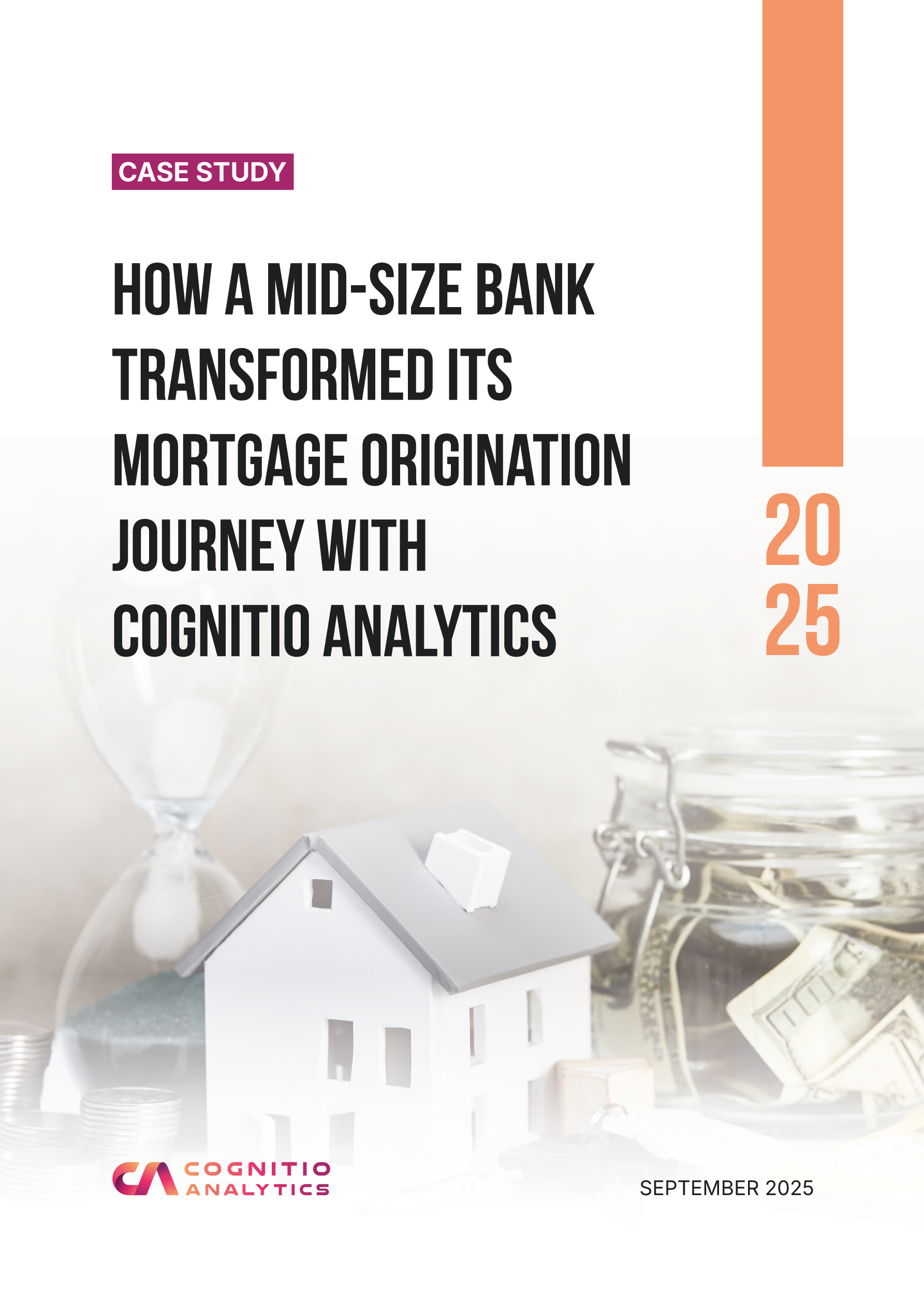
How a Mid-Sized US Bank Doubled Mortgage Origination Revenue Using Process Simulation
Why Process Simulation Matters More Than Ever
Modern organizations are complex ecosystems. A small change in one part of a process can produce ripple effects across systems, teams, compliance requirements, and customer experience.
Without simulation, decision-makers face three major risks:
- Prioritizing the wrong improvement
Intuition-driven choices often lead to expensive projects that don’t solve the real constraints. - Underestimating downstream consequences
Fixing one bottleneck can create another, unless the entire workflow is modeled. - Inability to quantify ROI
Without financial projections, competing initiatives have no objective basis for comparison.Process simulation eliminates these risks by providing:
• Predictive process outcomes
• Quantified financial impact
• Scenario comparisons
• Risk-free experimentation
• Data-driven investment prioritizationIt empowers teams to test ideas in a fully digital sandbox.
How Process Simulation Works in a Process Intelligence Environment
Simulation becomes extremely powerful when fed with accurate, real-world process data. Here’s how it interacts with the broader Process Intelligence stack:
- Process Mining Identifies the Opportunity
Process mining discovers bottlenecks, variations, and inefficiencies using actual event logs. In the bank’s case, QPR ProcessAnalyzer uncovered the document‑request bottleneck. - Machine Learning Predicts Future Behavior
Historical data trains models that forecast:
• Cycle time distributions
• Probabilities of exception cases
• Routing outcomes
• Acceptance rates
• Estimated workloads and volumesThis ensures simulations reflect real operational behavior instead of pure assumptions.
- Simulation Tests Alternative Process Designs
Teams can model:
• Automation introduction
• Staff reallocation
• New digital workflows
• Parallelization of steps
• Policy or rule changesEach simulation produces quantifiable outcomes.
- Financial Models Translate Operational Results into Business Value
By integrating cost and revenue variables, organizations can calculate:
• Net Present Value (NPV)
• Cost to implement
• Payback period
• Ongoing savings
• Throughput-driven revenue gainsThis is where transformation becomes strategic.
Strategic Benefits of Process Simulation
- Data-Driven Prioritization of Improvement Initiatives
Stop guessing which projects will deliver value. Simulations identify the best ROI. - Faster, More Confident Decision-Making
Executives accelerate approvals when they see quantified, risk-modeled outcomes. - Reduced Transformation Risk
Testing changes virtually avoids costly mistakes in production. - Increased Speed-to-Value
Organizations focus on initiatives that deliver maximum impact with minimum disruption. - Alignment Between Business, Operations, and Technology
Simulation outputs act as a common source of truth (for PMOs, operations leads, CIOs, and finance).
The Future: AI-Driven Autonomous Optimization
Today, simulation helps organizations choose the best improvement strategy. Tomorrow, AI models could:
- Continuously monitor process behavior
- Detect emerging bottlenecks
- Simulate solutions automatically
- Recommend or implement corrective actions
This is the dawn of autonomous processes; self-optimizing operational systems that adjust dynamically to volume, risk, and performance constraints. Organizations that adopt Process Intelligence + Simulation now are positioning themselves to lead in this next era.
Conclusion: Simulation Turns Process Intelligence into Business Intelligence
Our case study proves a critical truth:
Insight alone doesn’t create transformation. Thoughtful solution design based on simulation does.
By combining:
- Process mining for visibility
- Machine learning for prediction
- Simulation for outcome modeling
- Financial analysis for decision-making
Organizations move from reacting to problems to engineering outcomes. For the bank, that meant doubling mortgage origination revenue. For your organization, the impact could be even greater.
Reach out to us to learn how we can assist you.
Explore the Latest
Discover trends and strategies shaping smarter, faster business processes.